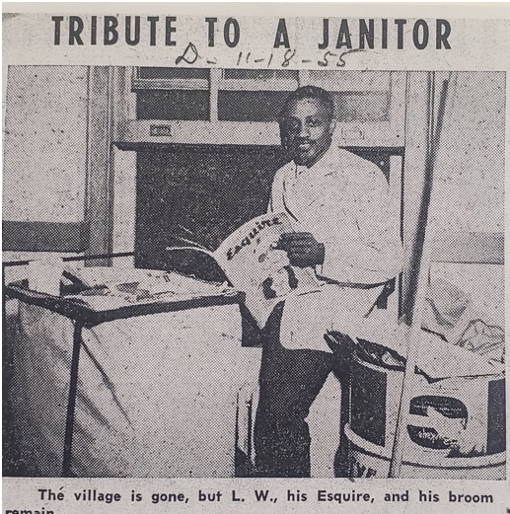
For several semesters, my students have been researching and completing entries on the African American men and women who worked as paid employees at Davidson College during the Reconstruction, Jim Crow, and early post-desegregation eras. Each semester, new challenges emerge for students. Inconsistent spelling of names and birth years in campus and public records forced students to confront the racial histories of the federal census, government records and campus archives. Since women primarily worked in the laundry, fraternities, and food services, students struggled in documenting their campus experiences and off-campus lives because the all-white male student body had limited interactions with them. Yet, students managed to construct meaningful biographies and document their memorials at their final resting places in the historic all-Black campus cemetery or a neighboring historic Black cemetery.
This semester students confronted another challenge posed by the socio-economic realities of early African American employees. Several profiled individuals lacked headstones. The surviving families buried them with full dignity and grace. They, however, lacked the financial resources to formally place a headstone. Several astute students noted even how the college community failed to assist the families of men and women who had toiled at the college for several decades. Students found it ironic that the campus could fundraise to create a Lost Cause monument dedicated to Hiram Potts following his death in 1917 but not for Stanford Holtzclaw, Percy Simolton Scales, J. Daniel Franks and others.[1]
While some students easily found the memorials of their assigned janitors, others had additional work. These student teams and I walked the Christian Aid Society Cemetery on campus and nearby Torrence Chapel AME Zion Cemetery. For some, we were able to find other interred family members and could infer where the unmarked memorial was located. Often, they encountered a slightly raised, grass-covered mound in between known family memorials. Others encountered broken headstones, a tree, or foliage marking the approximate location. These students also drew heavily on the available digitized death certificates, digitized wills and probate documents, published obituaries, and even published student newspaper articles eulogizing the fallen campus employees. As a result, these students took care in drafting and revising the memorial entries for the affected janitors. Students embraced “N/A” for the inscription field while noting the approximate location and its physical state in other required sections. They also described possible reasons for the lack of a headstone. In short, they performed the necessary care work required for our campus reparative contributions to the LSL project.[2]
Students recognized how the labor of African American staff sustained the college and advanced the lives and careers of students, faculty, and administrators. Yet, these unmarked memorials of these African American men and women made plain how their labor remained exploited over the Reconstruction, Jim Crow, and post-desegregation eras. As a result, students saw their work as more than a grade. The LSL project helped them to bear witness to the lives and experiences of individuals with and without headstones. Students’ careful recovery work allowed for the recirculation of this forgotten campus past while humanizing the post-slavery exploitative labor practices at the college. They saw their collective work as making significant contributions to ongoing efforts of healing and reconciling Davidson College’s racial past.
As Davidson College prepares to unveil a memorial to the enslaved and exploited African American workers, the challenge posed by the unmarked memorials enhanced classroom conversations about the LSL project and ongoing campus reconciliation efforts. They came to understand that college employment did not mitigate the poor socio-economic realities of these African American employees. While the campus community could praise early Black staff for their dedication and tenure, the college failed to honor these employees in death. We had many discussions about the reparative nature of LSL project in documenting the archival and material traces of early Black staff members’ final resting places while asking whether ground penetrating radar technology could be used to identify unmarked gravesites for the placement of a physical memorial in the present. Lastly, students and I asked how we, as a college community, be a better community partner to the current Christian Aid Society who still manages the active cemetery? We also contemplated ways to prevent such occurrences with current staff working in food services, maintenance and grounds. Ultimately, students turned the challenge posed by unmarked memorials into an enriching learning experience.
[1] “Uncle Hiram’s Grave Soon to Be Marked,” The Davidsonian, March 17, 1917, 2; “Uncle Hiram’s Tombstone Erected During Summer,” The Davidsonian, October 10, 1917, 3.
[2] See Aisha K. Finch, “Introduction: Black Feminism and the Practice of Care,” Palimpsest: A Journal on Women, Gender, and the Black International 11, no 1 (2022), 2, 11.